
The oil and gas industry operates in some of the most demanding environments on earth—extreme temperatures, high pressures, unstable geological formations, and complex fluid dynamics. In such conditions, every material used in drilling and production must perform reliably and predictably. One natural material has proven indispensable across decades of oilfield operations: bentonite.
Bentonite is far more than a simple clay. Thanks to its unique swelling behavior, fluid control properties, and thermal stability, bentonite in the oil and gas industry plays a central role in drilling efficiency, wellbore stability, and overall operational safety. From drilling fluids to oil well construction, bentonite remains a foundational component of modern oil and gas drilling systems.
This article provides a clear, experience-based explanation of why bentonite is used in oil drilling, how bentonite works in drilling fluids, and what makes it essential for oil and gas projects worldwide.
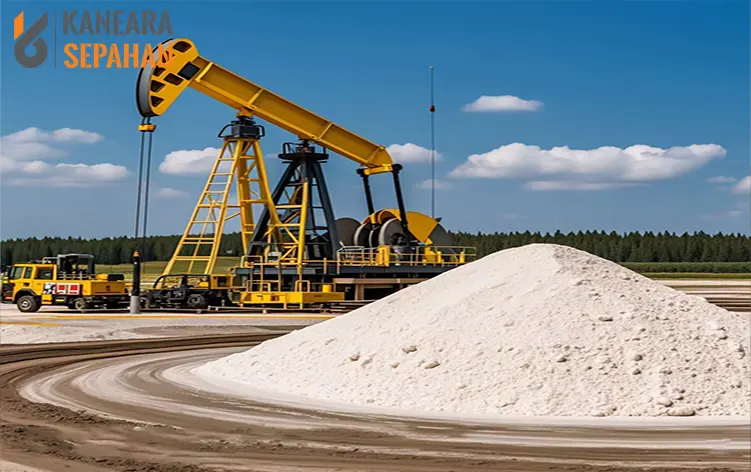
Bentonite is a naturally occurring clay primarily composed of montmorillonite, a mineral known for its ability to absorb water and expand significantly. This swelling property is the key reason bentonite is used in the oil and gas industry, particularly in drilling operations.
When hydrated, bentonite forms a stable, viscous suspension that can carry cuttings, seal permeable formations, and maintain pressure balance inside the wellbore. These characteristics make bentonite indispensable in oil well drilling, especially in water-based drilling systems.
High Thermal and Pressure Stability
Oil and gas drilling often occurs at great depths where temperature and pressure rise sharply. Bentonite maintains its functional properties under these harsh conditions, making it suitable for deep and extended-reach wells.
Exceptional Water Absorption and Swelling
One of the defining features of bentonite is its ability to absorb several times its weight in water. This swelling behavior enables effective viscosity control and formation sealing in drilling fluids.
Viscosity and Gel Strength Control
Bentonite helps regulate the rheological properties of drilling fluids, ensuring proper suspension of drill cuttings when circulation stops and smooth flow when pumping resumes.
Formation Sealing Capability
When bentonite swells, it creates a low-permeability filter cake along the wellbore wall. This helps prevent fluid loss into surrounding formations and reduces the risk of wellbore collapse.
The most common use of bentonite in the oil and gas industry is in drilling fluids, also known as drilling muds. Bentonite acts as the primary viscosifier in water-based drilling fluids.
Bentonite in drilling fluids helps to:
Without bentonite, drilling fluids would lack the structure and stability required for safe and efficient drilling.
Bentonite mud in oil drilling refers to water-based mud systems where bentonite provides the backbone of fluid performance. These muds are widely used in exploratory and development wells due to their cost-effectiveness, environmental compatibility, and operational reliability.
In oil drilling, bentonite mud:
Among different bentonite types, sodium bentonite for drilling is the most widely used in oil and gas operations. Sodium bentonite exhibits superior swelling, higher viscosity, and better suspension properties compared to calcium bentonite.
These characteristics make sodium bentonite ideal for:
Beyond drilling fluids, bentonite is also used during the well construction and completion stages of oil well drilling. Bentonite-based slurries help stabilize boreholes, support casing installation, and seal annular spaces.
This contributes to:
Understanding how bentonite works in drilling fluids requires looking at its interaction with water at a microscopic level. When bentonite particles hydrate, they disperse and form a network structure that increases fluid viscosity.
This network:
As a result, drilling fluids remain stable, controllable, and effective throughout the drilling process.
Improved Drilling Efficiency
Stable drilling fluids reduce non-productive time caused by stuck pipe, lost circulation, or borehole collapse.
Cost Reduction
Bentonite is a naturally abundant and cost-efficient material that reduces reliance on expensive synthetic additives, which is why bentonite price is a key consideration for cost-conscious oil and gas drilling projects.
Enhanced Equipment Protection
By lubricating drilling tools and reducing friction, bentonite helps extend equipment lifespan.
Environmental Compatibility
Water-based bentonite drilling fluids are generally more environmentally acceptable than oil-based systems, making them suitable for sensitive regions.
A common question is: Is bentonite used in the oil and gas industry in modern operations?
The answer is yes—extensively.
Despite advances in synthetic drilling additives, bentonite remains a core material due to its reliability, availability, and proven performance. Modern drilling fluid systems often combine bentonite with polymers and specialty additives, but bentonite remains the foundation.
While alternative viscosifiers exist, bentonite continues to be preferred because it offers:
For many oil and gas projects, bentonite strikes the optimal balance between performance, cost, and environmental considerations.

Not all bentonite is suitable for drilling. Oilfield applications require consistent particle size, controlled moisture content, and reliable swelling capacity. In many projects, API-grade sodium bentonite is specified to ensure performance consistency.
Selecting the right bentonite directly affects drilling success, fluid stability, and overall operational efficiency.