
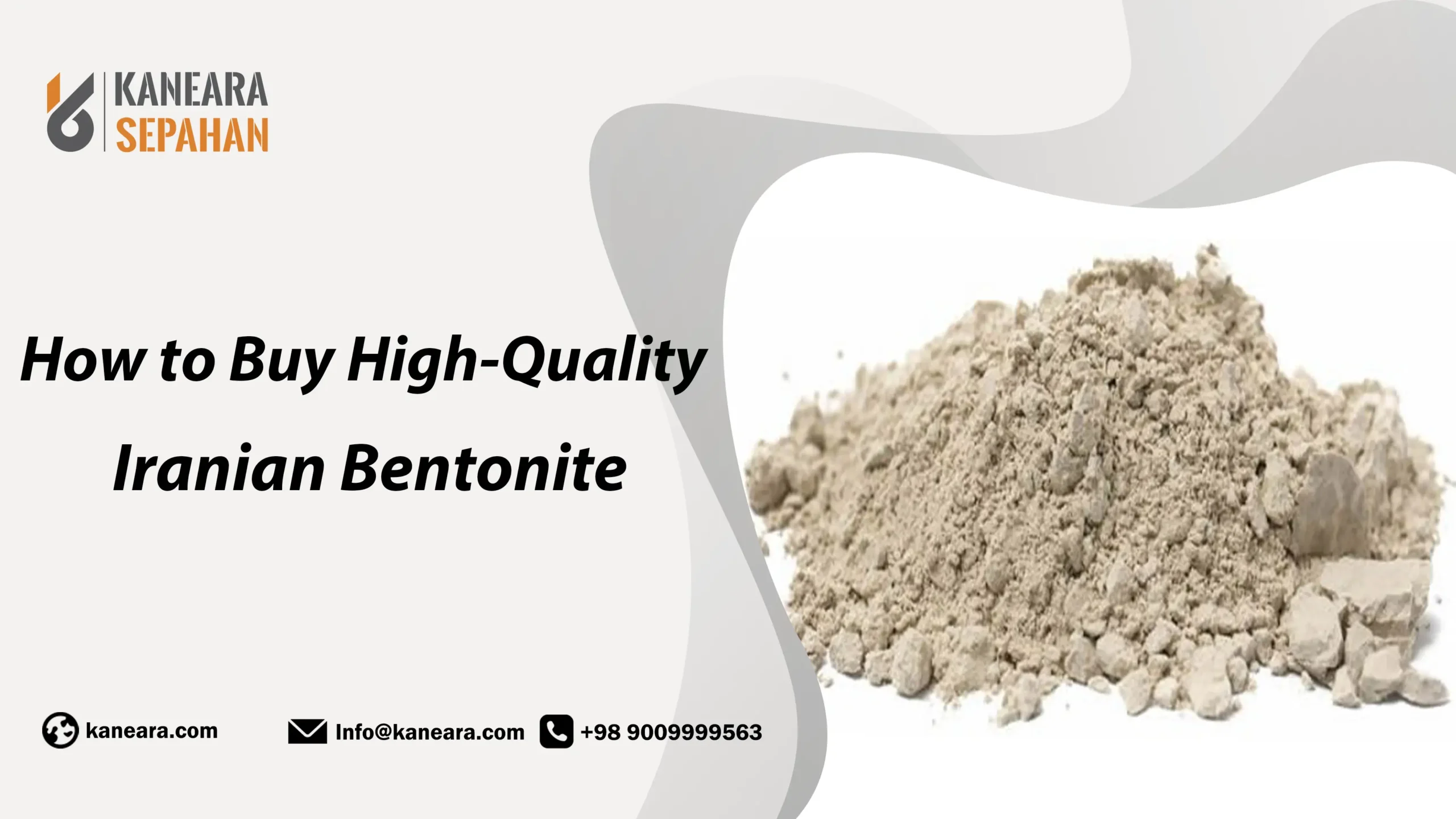
Buying bentonite for an industrial application is not simply a matter of finding the lowest price or choosing a supplier with the broadest product range. The right material depends on its mineral characteristics, performance requirements, processing level, packaging, documentation, and consistency from one shipment to the next.
For buyers sourcing bentonite from Iran, the same principle applies. Iranian deposits provide access to different grades and processing options, but the quality of the final product can vary depending on the source, processing method, specification, and intended application.
This guide explains what to check before buying Iranian bentonite, how to compare suppliers, and which questions to ask before placing a bulk order.
Iran has significant bentonite resources and an established mineral-processing sector. Iranian bentonite is supplied for several industrial applications, including drilling fluids, absorbent products, construction materials, agriculture, and other mineral-based products.
Buyers looking to buy bentonite should evaluate the specific grade and its intended application before placing an order. However, the origin alone does not determine whether a particular product is suitable for your application.
When evaluating Iranian bentonite, buyers should consider the properties of the specific grade rather than relying only on the country of origin. Swelling capacity, moisture, particle size, absorption, viscosity-related performance, mineral composition, and processing specifications can all affect how the material performs in production or field conditions.
For this reason, a reliable supplier should be able to provide product specifications and quality documentation for the actual grade being offered.
The first step is to define the application.
Different industries require different bentonite characteristics. A grade selected for drilling may not be appropriate for cat litter, construction, or another absorbent application.
Bentonite for Drilling Applications
Sodium-rich bentonite is commonly selected for drilling-related applications because of its ability to hydrate and swell in water. When evaluating bentonite drilling mud, buyers should consider how the material performs within their specific drilling system.
For drilling applications, requesting the supplier’s technical specification and laboratory data is particularly important because performance depends on the complete specification rather than the product name alone.
Bentonite for Cat Litter
Bentonite used in clumping cat litter is generally selected for its absorption and clumping behavior. When evaluating cat litter bentonite, buyers should consider several important factors, including:
The required specification can also vary depending on whether the product is intended for premium or economy litter formulations.
Bentonite for Construction and Other Industrial Uses
Bentonite can also be used in construction-related applications, waterproofing systems, binders, and other industrial formulations.
In these applications, the required properties may be different from those used in drilling or absorbent products. Buyers should therefore provide the supplier with the intended application before requesting a quotation.
A supplier’s product name is not enough to evaluate quality. Before placing an order, ask for information that allows you to compare the offered material against your technical requirements.
1. Product Specification
Request a technical data sheet or product specification showing the main characteristics of the grade.
Depending on the application, this may include:
Do not assume that a specification for one grade applies to all bentonite supplied by the same company.
2. Certificate of Analysis
A Certificate of Analysis (COA) can help confirm that the material supplied corresponds to the agreed specification.
Ideally, the documentation should identify the product or grade and provide measurable test results. Buyers handling large-volume shipments should also clarify whether testing is performed internally or by an independent laboratory.
3. Sample Evaluation
For a new supplier, requesting a sample before a bulk purchase is a practical way to reduce quality risk.
The sample should be evaluated under conditions that reflect your actual application. A bentonite that performs well in a simple laboratory test may still behave differently in a specific industrial formulation or process.
4. Consistency Between Shipments
For B2B buyers, consistency can be as important as the initial quality. A supplier should be able to explain how raw material selection, processing, blending, and quality control are managed to maintain a stable specification across shipments.
This is particularly important for manufacturers that use bentonite continuously and need predictable production results.
Price should be only one part of the comparison.
A lower quoted price may not represent a better commercial offer if the material requires additional processing, has inconsistent specifications, or creates higher transport and handling costs.
When comparing suppliers, consider:
Source and Traceability
Ask where the bentonite is extracted and whether the supplier can identify the mining source or production location.
Traceability helps buyers understand where the material comes from and improves communication when a specific grade needs to be reordered.
Processing Capability
Bentonite may be supplied in different forms and particle sizes depending on the application.
A supplier with processing capabilities can often provide material according to an agreed specification rather than supplying only untreated raw material.
Quality Control
Ask how the supplier checks incoming raw material and finished products.
Useful questions include:
Packaging
Packaging should match both the product and the logistics requirements.
Depending on the order and application, bentonite may be supplied in bags, big bags, or other bulk packaging formats. Packaging weight, palletization, moisture protection, labeling, and container loading should be agreed before shipment.
Export and Logistics Support
For international buyers, the supplier’s ability to handle export documentation and shipping arrangements can be as important as the material itself.
Before ordering, clarify:
There is no single price for Iranian bentonite because the final cost depends on several variables.
The main factors include:
For this reason, comparing suppliers only by price per ton can lead to misleading conclusions.
A better approach is to compare suppliers using the same technical specification, packaging format, order quantity, and delivery terms.
Kane Ara Sepahan is an Iranian mineral supplier and processor with more than 20 years of experience in mineral extraction, processing, and export.
For bentonite buyers, the key advantage is the ability to discuss the required application and specification before shipment rather than treating every bentonite grade as the same product.
Kane Ara can provide bentonite for different industrial requirements and supports international buyers with product specifications, samples, quality documentation, packaging, and export logistics.
For buyers evaluating a new source of Iranian bentonite, requesting the technical specification and sample before placing a bulk order is a practical first step.
Choosing the right bentonite supplier requires more than comparing prices. The most important factors are application suitability, technical specifications, quality documentation, sample evaluation, consistency, packaging, and reliable export support.
For companies looking to buy Iranian bentonite, the best approach is to define the required properties first and then compare suppliers using the same technical and commercial criteria. This makes it easier to identify a product that delivers reliable performance while reducing the risks associated with inconsistent quality or unsuitable grades.