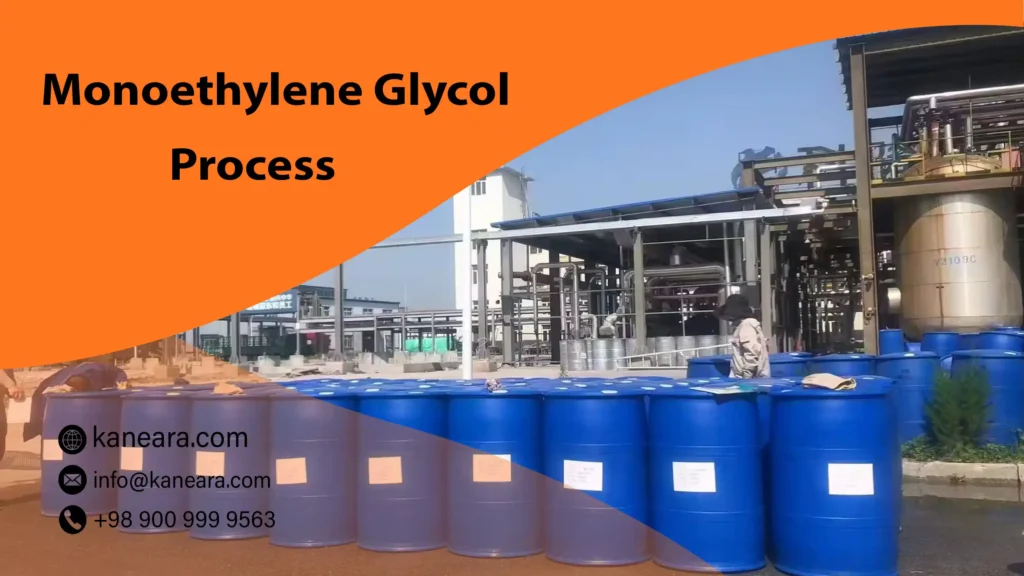
Monoethylene glycol (MEG) is produced mainly through a petrochemical process that starts with ethylene. The manufacturing process involves converting ethylene into ethylene oxide (EO) and then reacting EO with water to form monoethylene glycol.
Although the chemistry is relatively straightforward, commercial MEG production also requires separation, purification, and process control to achieve the high purity required for applications such as PET resin and polyester fiber production.
MEG Purification and Refining Process
monoethylene glycol (MEG) is produced through a multi-stage petrochemical process that begins with the conversion of ethylene into ethylene oxide (EO), followed by the reaction of EO with water to form ethylene glycol. The resulting mixture then undergoes several separation and purification steps to obtain high-purity MEG.
One of the most important stages of MEG production is purification and refining, as the reaction product contains water, diethylene glycol (DEG), triethylene glycol (TEG), and other impurities. Effective purification is essential for achieving the quality required for applications such as PET resin and polyester production.
The first step is water removal, typically carried out through multiple evaporation or concentration stages. The recovered water can be recycled back into the process to reduce water consumption.
After most of the water has been removed, distillation is used to separate MEG from heavier glycols such as DEG and TEG. Vacuum conditions may also be applied to lower boiling temperatures and minimize thermal degradation.
Finally, the purified MEG is cooled and transferred to storage. Efficient separation, heat integration, and process control help maximize MEG recovery while reducing energy consumption.
Conventional vs. Modern MEG Production
The conventional route uses the direct hydration of EO with water. It is well established for large-scale production, but the formation of DEG and TEG means that additional separation is required.
Modern catalytic processes can improve MEG selectivity. One example is the ethylene carbonate route, in which EO first reacts with carbon dioxide to form ethylene carbonate. The ethylene carbonate is then hydrolyzed with water to produce MEG.
This approach can significantly reduce the formation of heavier glycols and lower the amount of water required for the process. Shell, for example, describes its catalytic EO/EG technology as achieving MEG yields above 99% in this type of process.
Read more: What are Industrial Glycols
What Determines MEG Production Efficiency?
Several factors influence the efficiency and economics of MEG production:
- Catalyst performance: Higher selectivity in the EO stage can reduce raw material losses.
- Water-to-EO ratio: In conventional hydration, excess water helps favor MEG formation but increases the energy required for water removal.
- Reaction conditions: Temperature, pressure, residence time, and feed composition affect conversion and product distribution.
- Purification efficiency: Effective separation of MEG from DEG, TEG, and water is essential for producing high-purity MEG.
- Process integration: Recycling water and optimizing heat use can reduce energy consumption and operating costs.
MEG Production in Simple Terms
In simple terms, MEG is produced by converting ethylene into ethylene oxide and then converting ethylene oxide into ethylene glycol.
The simplified production chain is:
Ethylene → Ethylene Oxide → MEG-rich Glycol Mixture → Water Removal → Distillation → Purified MEG
This final purification stage is especially important for applications that require tightly controlled MEG quality, including PET resin and polyester fiber production.
Frequently Asked Questions Production method of MEG
1- Is MEG made from ethylene?
Yes. Commercial MEG production commonly starts with ethylene, which is first converted into ethylene oxide and then into ethylene glycol.
2- What is the main reaction used to produce MEG?
The key reaction is the hydration of ethylene oxide with water:
Ethylene oxide + water → monoethylene glycol
3- Are DEG and TEG produced during MEG manufacturing?
Yes. In the conventional process, some DEG and TEG are formed as by-products and must be separated from MEG during purification.
4- Why does MEG need to be purified?
Purification removes water and heavier glycols such as DEG and TEG, allowing manufacturers to produce MEG that meets the specifications required for different applications.
5- Is all MEG produced using the same process?
No. The conventional direct hydration route remains an important production method, while newer catalytic processes use alternative reaction pathways to improve MEG selectivity and reduce water and energy requirements.