Reliable quality control depends on more than a supplier’s general specifications. Buyers need to verify whether laboratory results are traceable to the supplied batch, whether measurable properties meet process requirements, and whether the final shipment conforms to the agreed criteria.
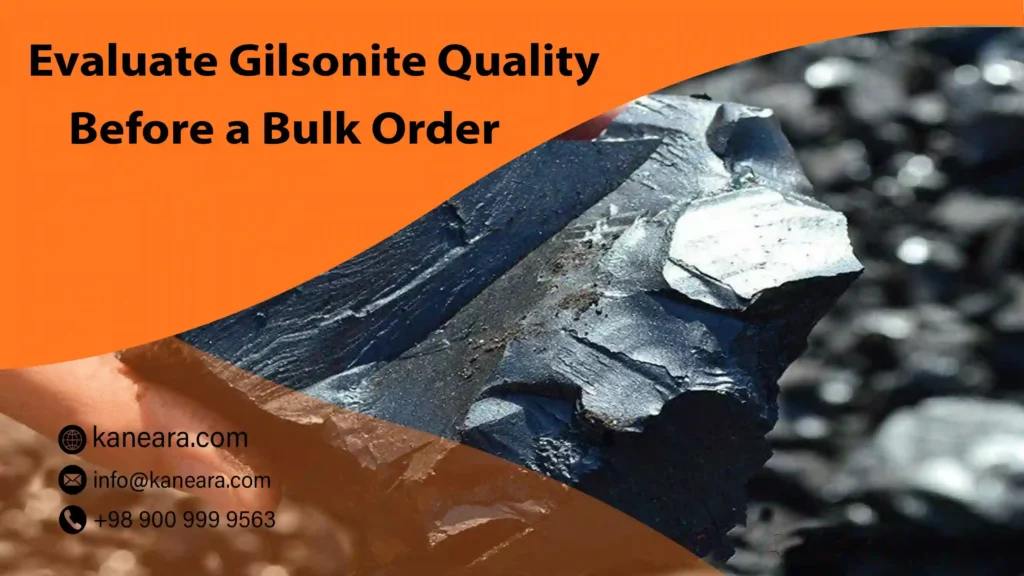
Evaluate Gilsonite Quality before a Bulk Order
1. Check the Certificate of Analysis (COA)
A Certificate of Analysis provides measured quality data for a particular batch of material. It helps buyers verify whether the supplied Gilsonite meets the agreed purchasing specifications.
Before approving a COA, check the following:
- Batch or lot number: Confirm that the document identifies the relevant production batch.
- Test results: Review the reported values for ash content, particle size, moisture, softening point, and any other parameters required for your application.
- Test methods: Check which methods were used and whether the results are comparable with your technical requirements.
- Testing date and traceability: Ensure the document is current and can be linked to the material being supplied.
- Specification compliance: Compare the actual results with the limits agreed in your purchase order.
A Technical Data Sheet (TDS) generally describes product specifications or typical properties, whereas a COA should report test results for an identified batch.
Practical tip: Request a batch-specific COA and clarify any missing results before approving the order. A general specification sheet alone does not confirm the quality of a specific shipment.
2. Evaluate Ash Content against Your Requirements
Ash content represents the non-combustible residue remaining after a material is tested under specified conditions. In gilsonite, it indicates the proportion of inorganic residue present in the tested sample.
A lower ash percentage is not automatically the best choice for every application. The acceptable level depends on your formulation, performance requirements, and agreed product grade.
When reviewing ash content:
- Define an acceptable range: Specify the required maximum or range before ordering.
- Check the reporting basis: Confirm the test method and whether the result is reported on a dry basis or as received.
- Compare like with like: Evaluate suppliers using the same specifications and comparable testing methods.
- Verify batch consistency: Check that the reported value falls within the agreed tolerance rather than relying on claims such as “high purity” or “low ash.”
The objective is to secure a consistent grade that meets your process requirements, not simply to select the lowest reported ash value.
3. Match Particle Size to Your Industrial Process
Particle size affects how Gilsonite behaves during handling, mixing, dispersion, and processing. The appropriate size distribution of gilsonite powder depends on the equipment and formulation used by the buyer.
Before placing an order, confirm the following:
- Required mesh size: Specify the target mesh or particle-size range according to your process requirements.
- Percentage passing through the sieve: A mesh designation alone may not fully describe the material. Ask for the percentage passing through the specified sieve and, where necessary, the complete particle-size distribution.
- Testing method: Confirm the sieve standard or particle-size measurement method used by the supplier so that results can be compared consistently.
- Process compatibility: Consider whether the material will mix, disperse, or feed properly in your existing production system. Finer powder is not necessarily better; the appropriate distribution depends on the application.
For example, a buyer who requires consistent powder feeding should verify particle-size distribution across the batch rather than relying solely on a nominal mesh number.
Read more: What is gilsonite?
4. Verify That the Bulk Shipment Matches the Approved Sample
An approved sample does not automatically guarantee that the final shipment will have the same properties. Buyers should establish a documented process for checking whether the delivered material meets the agreed specifications.
Before confirming the order:
- Approve a representative sample: Test it under your own process conditions whenever practical.
- Record the approved specifications: Document the acceptable ash content, particle-size requirements, and other critical parameters.
- Agree on tolerances: Define acceptable variation and how non-conforming material will be handled.
- Link the sample to the order: Keep the sample identification, COA, and purchase specifications in your procurement records.
- Request pre-shipment verification: Ask the supplier to confirm that the shipment meets the agreed specifications.
For higher-risk orders, consider independent laboratory testing or inspection.
When the shipment arrives, check the packaging and batch identification, inspect the material, and arrange testing when required. If results fall outside the agreed limits, document the discrepancy before using the material in production.
5. Bulk Gilsonite Quality Checklist
Before issuing a purchase order, confirm that:
- The COA identifies the relevant batch and includes the required test results.
- Ash content falls within the agreed acceptance range.
- Particle size and distribution match your process requirements.
- The approved sample and final shipment are covered by the same quality specifications.
- Inspection procedures and actions for non-conforming material are agreed upon in writing.
Conclusion
Effective quality assessment requires traceable test results, clearly defined acceptance limits, and a documented process for verifying the delivered material. Checking the COA, ash content, particle-size distribution, and sample-to-shipment consistency helps buyers identify potential quality risks before they affect production.
To discuss technical requirements for a specific application, review the Gilsonite product range and communicate your required specifications, order quantity, packaging, and destination to the supplier before finalizing the purchase.