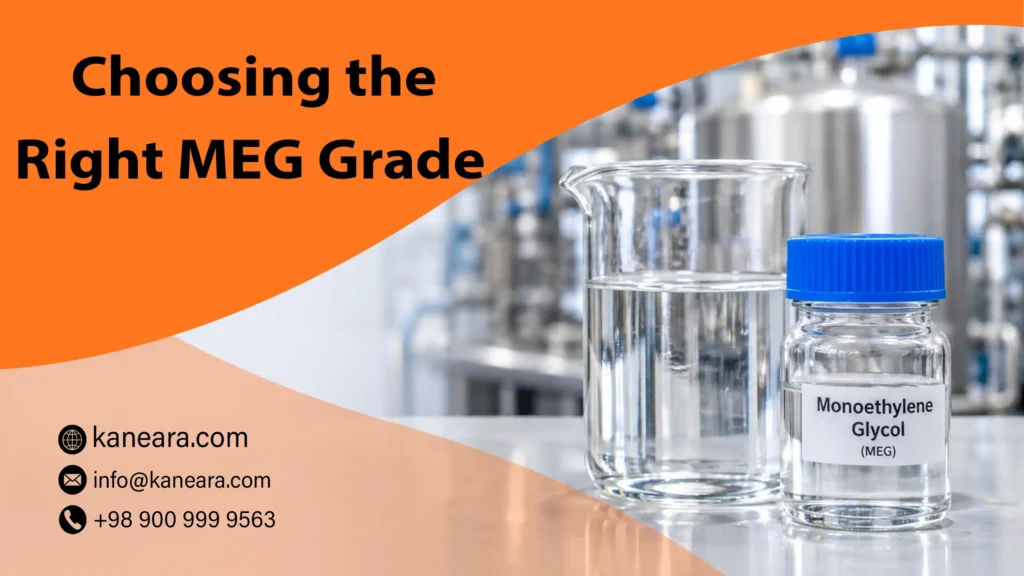
Choosing the right Monoethylene Glycol (MEG) grade is essential for achieving consistent product quality, maintaining process efficiency, and meeting industrial specifications. Although all MEG grades contain the same primary chemical compound, they differ in purity, impurity limits, and other technical properties.
The main commercial MEG grades include polyester grade, industrial grade, antifreeze grade, and low conductivity grade. Each is designed to meet the requirements of specific applications.
The right choice depends on how MEG will be used, how sensitive your production process is to impurities, and which specifications your final product must meet.
Understanding Commercial MEG Grades
MEG, also known as ethylene glycol or 1,2-ethanediol, is a versatile chemical used in polyester production, antifreeze formulations, heat transfer fluids, and several other industrial applications.
Commercial MEG grades are primarily distinguished by their technical specifications rather than their chemical identity. Important differences include:
- Purity: The percentage of monoethylene glycol in the product.
- Diethylene Glycol (DEG): A common glycol impurity that may affect downstream processing.
- Water Content: Important in processes that require controlled moisture levels.
- Acidity: Relevant to chemical stability and process compatibility.
- Iron and Chloride Content: Important where trace contaminants can affect product quality.
- Color and UV Transmittance: Useful indicators of product quality, particularly for polyester manufacturing.
These parameters determine whether a specific MEG product is suitable for a particular industrial process.
Polyester Grade vs. Industrial Grade MEG
Polyester grade and industrial grade MEG are two common commercial options, but they are intended for different levels of process sensitivity.
Polyester Grade MEG
Polyester grade MEG is a high-purity material primarily used in the production of polyester fibers, films, and PET resins.
Because impurities can affect polymerization and the quality of the final product, this grade has stricter limits for parameters such as DEG, water, iron, chlorides, and aldehydes.
Typical applications include:
- PET resin and bottle manufacturing
- Polyester staple fiber and filament yarn production
- Polyester films and related materials
For manufacturers requiring consistent polymer quality, polyester grade MEG is generally the preferred option.
Read more: MEG for PET Resin and Polyester Fiber
Industrial Grade MEG
Industrial grade MEG is suitable for applications that do not require the same strict impurity limits as polyester manufacturing.
It is commonly considered for industrial formulations, chemical processing, and applications where the buyer’s process specifications permit a wider range of impurity levels.
However, industrial grade does not mean that every product with this label has identical quality. Buyers should always compare the supplier’s actual technical specifications with their process requirements.
Antifreeze Grade MEG
Antifreeze grade MEG is primarily used as a raw material in the production of antifreeze and coolant formulations.
Its ability to lower the freezing point of water makes it useful in automotive cooling systems, industrial cooling circuits, and other heat transfer applications.
Compared with polyester grade, antifreeze grade generally allows higher levels of certain impurities and lower MEG purity.
Typical applications include:
- Automotive antifreeze and coolant production
- Industrial cooling systems
- Heat transfer fluid formulations
- Deicing fluid production
Important: Antifreeze grade MEG is not necessarily a ready-to-use coolant. Final coolant formulations may require water, corrosion inhibitors, and other additives to meet system and manufacturer requirements.
For engine coolant applications, buyers should also check whether the supplied glycol complies with the relevant requirements of ASTM E1177 and the intended OEM specifications.
Low Conductivity MEG
Low conductivity MEG is designed for applications where controlling ionic impurities is particularly important.
In these applications, trace metals and inorganic contaminants may influence the electrical properties or performance of the final formulation.
Compared with conventional industrial grade MEG, low conductivity grade typically has tighter limits for certain impurities, particularly iron and other ionic contaminants.
When evaluating this grade, buyers should request the supplier’s electrical conductivity value, measurement temperature, and relevant impurity limits. A low conductivity grade designation alone does not establish a universal conductivity threshold.
It is also important to distinguish low conductivity MEG from a finished low conductivity coolant. The addition of water and chemical additives can significantly change the electrical conductivity of the final fluid.
Key Specifications of Different MEG Grades
The following table compares selected commercial monoethylene glycol grades using MEGlobal’s published sales specifications, updated January 2024. These figures are examples from one producer and should not be treated as universal industry limits.
| Antifreeze Grade | Low Conductivity Grade | Industrial Grade | Polyester Grade | Specification |
|---|---|---|---|---|
| 95.0 | 99.8 | 99.1 | 99.9 | MEG Purity (min. wt %) |
| 5.0 | 0.1 | 0.6 | 0.05 | DEG (max. wt %) |
| 0.5 | 0.1 | 0.3 | 0.05 | Water (max. wt %) |
| 100 | 20 | 20 | 20 | Acidity (max. ppm) |
| 25 | 5 | 10 | 5 | Color (max. Pt-Co) |
Other specifications may also be important. For example, MEGlobal’s polyester grade specification includes UV transmittance requirements and a maximum total aldehyde content, while its low conductivity grade specifies a maximum iron content of 0.05 ppm.
These differences show why comparing MEG products based only on purity is not sufficient. The full specification must match the intended application.
Read more: How Monoethylene Glycol Is Produced
How to Select the Right MEG Grade?
Selecting the right MEG grade requires more than identifying the application. Buyers should also consider process conditions, quality requirements, and supplier documentation.
Use the following steps to make a more informed decision:
- Identify the end application: Determine whether MEG will be used in PET resin manufacturing, polyester fiber production, coolant formulations, or another industrial process.
- Define the required purity: Check the minimum MEG content accepted by your production process. High-purity applications generally require tighter impurity limits.
- Check critical impurities: Review the limits for DEG, water, iron, chlorides, and acidity. Some applications are more sensitive to specific contaminants than others.
- Review the technical specification: Request the product’s Technical Data Sheet (TDS) and Certificate of Analysis (COA). Verify the test methods and confirm that the actual batch results meet your requirements.
- Confirm supplier consistency: For bulk purchases, evaluate whether the supplier can maintain consistent specifications across different shipments and provide the necessary quality documentation.
Ultimately, the best MEG grade is not necessarily the one with the highest purity. It is the grade that meets your technical requirements without creating unnecessary procurement costs.
Final Considerations
Selecting the right Monoethylene Glycol grade starts with understanding your production requirements. Polyester grade is generally preferred for PET and polyester manufacturing, industrial grade serves applications with less restrictive impurity limits, antifreeze grade is used in coolant formulations, and low conductivity grade is intended for applications requiring tighter control of ionic contaminants.
Before placing a bulk order, compare the supplier’s technical specifications with your required limits and request a batch-specific COA.
Frequently Asked Questions
1- What is the difference between polyester grade and industrial grade MEG?
Polyester grade MEG has stricter limits on impurities and is mainly used in PET resin, polyester fiber, and film production. Industrial grade MEG allows wider impurity limits and is suitable for industrial applications with less demanding purity requirements.
2- Which MEG grade is used for antifreeze production?
Antifreeze grade MEG is commonly used as a base material for manufacturing antifreeze and coolant formulations. The final product may require additional ingredients, including corrosion inhibitors.
3- What is low conductivity MEG used for?
Low conductivity MEG is intended for processes and formulations where ionic impurities and electrical properties need tighter control. Buyers should confirm the required conductivity and impurity limits with their supplier.
4- Is 99.9% purity MEG suitable for every industrial application?
Not necessarily. While high purity is important for sensitive applications, other parameters such as water, DEG, iron, chloride, and acidity may be equally important. The complete product specification should match the intended process.