Monoethylene glycol (MEG) is the diol that reacts with purified terephthalic acid (PTA) to build polyethylene terephthalate (PET) — the polymer behind PET resin (bottles, preforms, film) and polyester fiber (yarn, staple, filament). Producing one tonne of PET typically consumes about 0.33–0.35 tonnes of MEG alongside roughly 0.84–0.86 tonnes of PTA. For PET and polyester manufacturers, MEG purity isn’t a side detail — it sets the color, strength, and processability of the finished polymer.
How MEG Becomes PET Resin and Polyester Fiber
PET is built from MEG and PTA through two linked reaction stages:
- Esterification — MEG and PTA react at roughly 250–260°C, releasing water and forming the monomer bis(2-hydroxyethyl) terephthalate (BHET).
- Polycondensation — BHET units link into long polymer chains under heat and vacuum, releasing further MEG (recovered and recycled in most plants) as intrinsic viscosity (IV) builds.
The chemistry is the same whether the output becomes PET resin or polyester fiber. What differs is downstream processing: PET resin is chipped and either injection-molded into bottles and preforms or cast into film, while fiber-grade polymer is melt-spun through spinnerets into filament or staple fiber for yarn, apparel, and nonwovens.
PET & Polyester Production Process Using MEG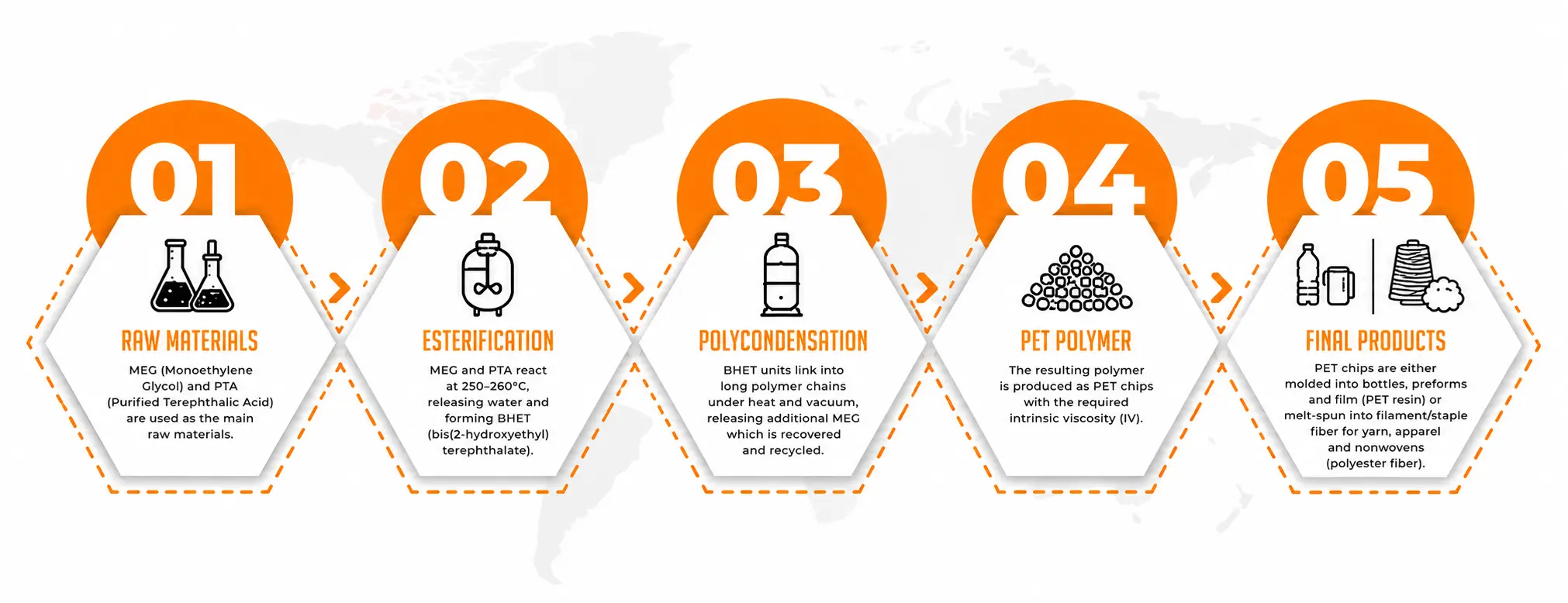
MEG Specifications for Polymer-Grade Use
PET and polyester producers work to tight incoming-material specs because monoethylene glycol impurities carry straight through into the finished polymer. Typical polymer-grade (fiber and PET) MEG specifications:
| Property | Typical Specification | Test Method |
| Purity (assay) | 99.9% wt min | ASTM E2409 |
| Diethylene glycol (DEG) | ≤0.03% wt | ASTM E2409 |
| Water content | ≤0.1% wt | Karl Fischer |
| Color (Pt-Co / APHA) | ≤5 | ASTM D1209 |
| Acidity (as acetic acid) | ≤2 mg/kg | ASTM E2679 |
| Iron | ≤1 mg/kg | ASTM E1615 |
| Ash | ≤0.001% wt | ASTM D482 |
Why each parameter matters:
- DEG content lowers the polymer’s melting point and reduces fiber tenacity and dye uptake, so polyester spinners keep it especially tight.
- Color (APHA) carries directly into PET clarity for bottles and whiteness for fiber — a few extra Hazen units are visible in the finished product.
- Iron and ash can poison the polycondensation catalyst or cause discoloration under the sustained heat of continuous spinning.
- Water content shifts esterification stoichiometry and can extend reaction time or affect IV build.
MEG for PET Resin
PET resin is produced by polymerizing PTA and MEG. After polymer formation and further processing, PET can be converted into different grades depending on the intended application.PET resin is commonly used for:
- Beverage and food packaging
- Plastic bottles and containers
- Packaging films
- Sheets and other molded products
The required resin characteristics depend on the final application. For example, bottle-grade PET requires properties that support clarity, strength, and processing performance.
Read more: What are Industrial Glycols
MEG for Polyester Fiber
MEG is also essential for producing polyester fiber, because polyester is a PET-based polymer.
After polymerization, PET can be melted and converted into fibers through spinning and subsequent fiber-processing steps. Depending on the production route and finishing process, the material can be used to produce filament yarn, staple fiber, and other textile materials.
Polyester fibers are widely used in:
- Clothing and apparel
- Home textiles
- Industrial textiles
- Upholstery and furnishing materials
- Blended fabrics
The properties of polyester, such as strength, durability, and resistance to wrinkling, make it suitable for both consumer and industrial textile applications.
Conclusion
MEG plays a fundamental role in the PET and polyester value chain. Its reaction with PTA produces PET, which can then be processed into PET resin, packaging materials, films, and polyester fibers. Understanding this relationship helps manufacturers, distributors, and industrial buyers better evaluate the role of MEG within the broader polyester industry.
Frequently Asked Questions about MEG for PET Resin and Polyester Fiber
1- Is MEG used to make PET resin?
Yes. MEG is one of the principal raw materials used with PTA to produce PET polymer, which is then processed into different PET resin grades and products.
2- Is MEG used in polyester fiber production?
Yes. PET-based polyester fiber is produced from polymer made using MEG and a terephthalate-based raw material.
3- What is the difference between MEG and PET?
MEG is a chemical raw material, while PET is the polyester polymer produced from raw materials including MEG.
4- Why is MEG important in the polyester industry?
MEG is a fundamental building block of PET, which is used for both packaging applications and polyester fibers.
5- What industries use PET made with MEG?
Major downstream applications include packaging, bottles, films, textiles, and polyester fiber products.