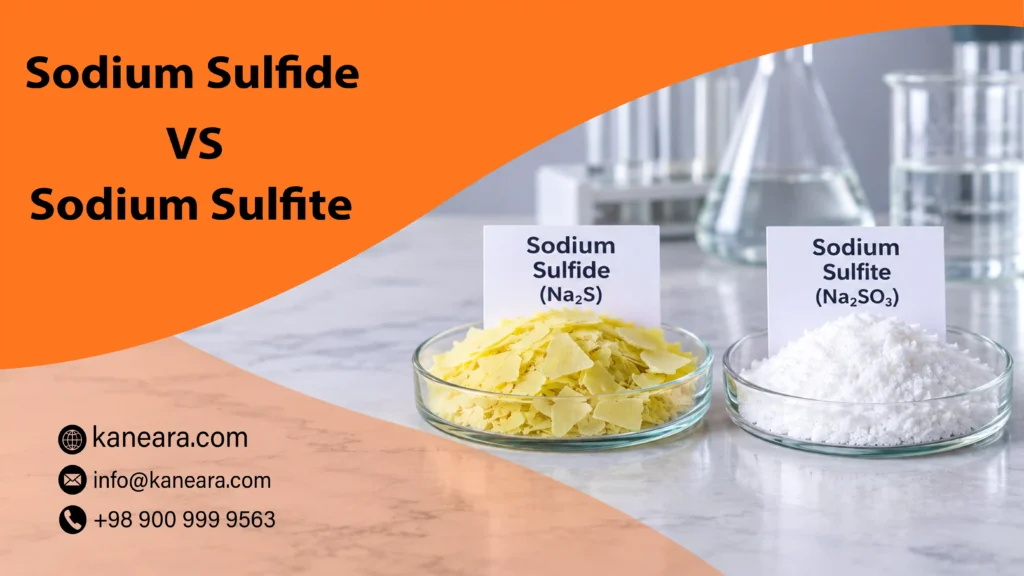
Sodium sulfide (Na₂S) and sodium sulfite (Na₂SO₃) are two inorganic sodium salts used in various industrial applications. Although their names are similar, they have different chemical structures, properties, reactions, and functions.
The main difference is that sodium sulfide is primarily used in leather processing, metal recovery, and ore treatment, while sodium sulfite is widely used as a reducing agent, oxygen scavenger, and dechlorination chemical in industrial water treatment.
Understanding these differences is essential when selecting the right chemical for an industrial process.
What Is the Difference Between Sodium Sulfide and Sodium Sulfite?
The main difference between sodium sulfide and sodium sulfite is their sulfur-containing anions.
- Sodium sulfide (Na₂S) contains the sulfide ion (S²⁻), in which sulfur has an oxidation state of -2.
- Sodium sulfite (Na₂SO₃) contains the sulfite ion (SO₃²⁻), in which sulfur has an oxidation state of +4.
This difference directly affects their chemical behavior and industrial applications.
Sodium Sulfide vs. Sodium Sulfite: Comparison Table
| Sodium Sulfite | Sodium Sulfide | Property |
|---|---|---|
| Na₂SO₃ | Na₂S | Chemical formula |
| 7757-83-7 | 1313-82-2 | CAS number |
| 126.04 g/mol | 78.04 g/mol | Molecular weight (anhydrous) |
| Sulfite (SO₃²⁻) | Sulfide (S²⁻) | Main ion |
| +4 | -2 | Sulfur oxidation state |
| White powder or crystals | White to yellow crystals or flakes | Typical appearance |
| Reducing agent and oxygen scavenger | Sulfide source and reducing agent | Key chemical function |
| Water treatment, boiler systems, paper and textile processing | Leather tanning, mining, metal precipitation | Major applications |
Key Chemical and Safety Differences Between Sodium Sulfide and Sodium Sulfite
Although both chemicals contain sulfur, they behave differently when exposed to acids.
This is one of the most important differences from an industrial safety perspective.
Sodium sulfide and acids: When sodium sulfide reacts with an acid, it can release hydrogen sulfide (H₂S), a highly toxic and flammable gas.
Na₂S + 2HCl → 2NaCl + H₂S↑
Sodium sulfite and acids: When sodium sulfite reacts with strong acids, it can release sulfur dioxide (SO₂), a toxic and irritating gas.
Na₂SO₃ + 2HCl → 2NaCl + H₂O + SO₂↑
Both chemicals require appropriate storage, ventilation, personal protective equipment, and handling procedures. They must not be mixed with incompatible substances, and their specific Safety Data Sheets (SDS) should always be followed.
Read more: What Is Sodium Sulfite?
Which One Should You Choose: Sodium Sulfide or Sodium Sulfite?
The right choice depends on the intended industrial application and the chemical reaction required.
| Recommended Chemical | Industrial Requirement |
|---|---|
| Sodium sulfide | Removing hair from animal hides |
| Sodium sulfide | Sulfide-based ore processing |
| Sodium sulfide | Precipitating dissolved metals in wastewater |
| Sodium sulfite | Removing dissolved oxygen from boiler feedwater |
| Sodium sulfite | Dechlorinating industrial water |
| Sodium sulfite | Selected reducing and bleaching processes |
Important: Sodium sulfide and sodium sulfite are not interchangeable. Choosing the wrong chemical can reduce process efficiency, affect product quality, and create safety risks.
Before purchasing, industrial buyers should consider the required purity, concentration, physical form, hydration state, technical specifications, and application requirements.
Read more: What Is Sodium Sulfide?
Conclusion
Sodium sulfide and sodium sulfite may have similar names, but they serve different purposes in industrial applications.
Sodium sulfide (Na₂S) is mainly used in leather processing, mining, metal recovery, and chemical manufacturing. In contrast, sodium sulfite (Na₂SO₃) is primarily valued for its reducing properties, especially in boiler water treatment, dechlorination, and selected paper and textile processes.
Understanding their chemical differences helps manufacturers and industrial buyers select the appropriate chemical, improve process efficiency, and maintain safe operating condition
Frequently Asked Questions
1- Is sodium sulfide the same as sodium sulfite?
No. Sodium sulfide (Na₂S) and sodium sulfite (Na₂SO₃) are different chemical compounds. Sodium sulfide contains sulfide ions, while sodium sulfite contains sulfite ions.
2- What is the main difference between Na₂S and Na₂SO₃?
The main difference is their chemical structure and sulfur oxidation state. Sodium sulfide contains sulfur at -2, whereas sodium sulfite contains sulfur at +4. As a result, they have different chemical properties and industrial uses.
3- Can sodium sulfide replace sodium sulfite?
No. Although both chemicals can act as reducing agents in certain reactions, their functions and chemical behavior are different. They should only be selected according to the requirements of the specific process.
4- Which chemical is used for water treatment?
Both chemicals have water-treatment applications, but for different purposes. Sodium sulfide is used to precipitate certain dissolved metals, while sodium sulfite is commonly used for oxygen removal and dechlorination.
5- Is sodium sulfide more dangerous than sodium sulfite?
Their hazards are different. Sodium sulfide presents a serious risk because contact with acids can release highly toxic and flammable hydrogen sulfide gas. Sodium sulfite can release toxic sulfur oxides when exposed to strong acids and may irritate the respiratory system. Both require appropriate