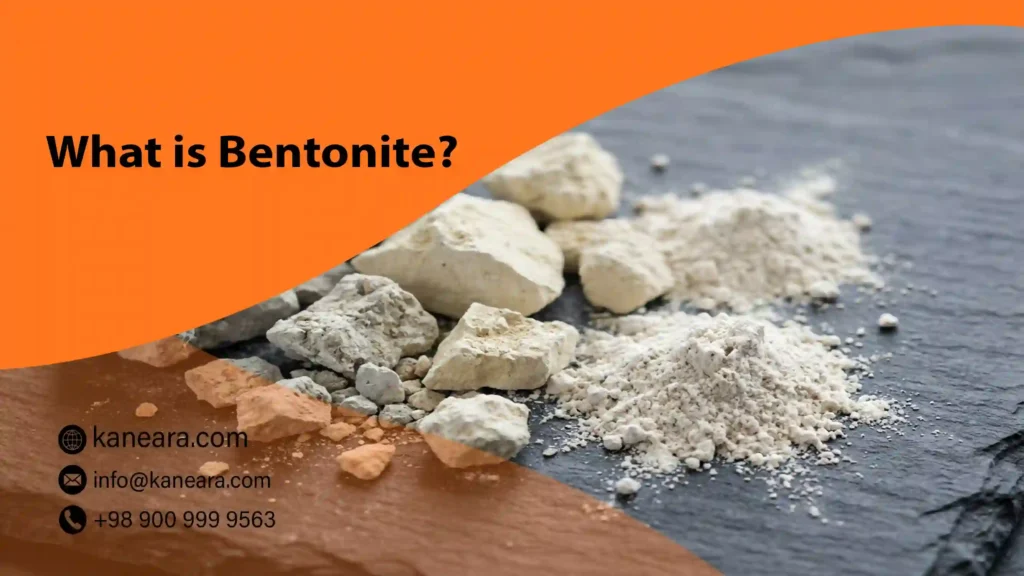
Bentonite is a naturally occurring clay material formed mainly from montmorillonite. It is best known for its ability to interact with water: depending on its mineral composition, bentonite can absorb water, swell, form a gel, bind particles, or adsorb certain substances.
These properties make bentonite useful in many industrial and technical applications, including drilling fluids, foundry molding, construction, environmental containment, iron ore pelletizing, purification, agriculture, and absorbent products.
However, bentonite is not a single uniform material. Its behavior depends on factors such as mineral composition, the type of exchangeable ions present, particle size, processing, and the conditions in which it is used.
This guide explains what bentonite is, how it works, its main properties, the difference between sodium and calcium bentonite, its major applications, and the factors that influence its performance.
What Is Bentonite Made Of?
Bentonite is a clay-rich material formed mainly from volcanic ash that has undergone alteration over geological time. Its principal clay mineral is montmorillonite, which belongs to the smectite group.
Montmorillonite has a layered structure. Water and certain ions can enter the spaces between these layers, allowing the material to expand and interact with surrounding substances.
This structure is responsible for several of the properties associated with bentonite, including:
- water absorption
- swelling
- particle suspension
- adsorption
- ion exchange
- binding
- low permeability after hydration
The exact composition varies from one deposit to another. As a result, bentonite obtained from different geological sources can behave differently even when both materials are described by the same general name.
How Does Bentonite Work?
The behavior of bentonite becomes easier to understand by looking at what happens when it comes into contact with water.
- Water Absorption and Swelling
When hydrated, montmorillonite particles take up water between their layers. This causes the particles to expand.
The degree of expansion depends on the mineral composition and particularly on the dominant exchangeable cations. Sodium-rich bentonite generally develops greater swelling than calcium-rich material under comparable conditions.
This swelling behavior is important in applications where the clay is expected to form a seal or maintain a stable fluid structure.
- Gel Formation and Suspension
Dispersed bentonite particles can create a three-dimensional network in water. This gives the fluid viscosity and allows solid particles to remain suspended.
This characteristic is particularly important in drilling fluids, where the fluid must transport cuttings while remaining pumpable under operating conditions.
- Adsorption and Ion Exchange
Montmorillonite has a relatively large reactive surface area and cation-exchange capacity. These characteristics allow bentonite to interact with dissolved substances and suspended particles.
This is one reason certain grades are used in purification, clarification, and other processes where adsorption is useful.
- Binding
Bentonite can also bind fine particles together. This property is particularly valuable in applications such as foundry molding and iron ore pelletizing, where the material needs to hold particles together during processing.
What Are the Main Types of Bentonite?
Commercial bentonite is commonly classified according to its dominant exchangeable cation and resulting behavior. The two types most frequently discussed are sodium bentonite and calcium bentonite.
1- Sodium Bentonite
Sodium bentonite generally has a high capacity to absorb water and swell. When hydrated, it can form a dense gel with relatively low permeability.
These characteristics make sodium-rich grades particularly useful in applications involving drilling fluids, sealing, waterproofing, slurry systems, and containment.
The exact performance of a sodium bentonite product still depends on its montmorillonite content, particle size, processing, and the water or operating conditions involved.
2- Calcium Bentonite
Calcium bentonite generally exhibits lower swelling than sodium-dominant material, but it can provide useful adsorption, rheological, and binding characteristics.
Its properties make calcium-rich grades relevant to applications such as foundry processes, purification, absorbent products, agriculture, and other industrial uses.
The distinction between sodium and calcium bentonite is therefore not simply a matter of one being better than the other. Each behaves differently and is suited to different technical requirements.
What Is Bentonite Used For?
Bentonite is used across a wide range of industries because different applications take advantage of different properties.
Drilling Fluids
One of the best-known applications is drilling. Bentonite can be dispersed in water to create a drilling fluid with viscosity, suspension, and filtration-control properties. These characteristics make it a valuable material for the oil and gas industry, particularly where drilling fluids are required to transport cuttings and support wellbore stability.
In drilling operations, these characteristics can help:
- carry drilled cuttings toward the surface
- support the borehole wall
- reduce fluid filtration into suitable formations
- lubricate parts of the drilling system
- maintain the required rheological behavior of the fluid
The material is also widely used in water-well drilling and horizontal directional drilling (HDD), where drilling fluids need to transport cuttings and provide borehole support.
Construction and Civil Engineering
Bentonite has several important uses in underground construction.
A bentonite slurry can support excavated walls during the construction of diaphragm walls and slurry trenches. Once hydrated, the clay helps maintain a stable suspension and limits water movement through the system.
Bentonite is also incorporated into geosynthetic clay liners and other waterproofing systems. In these applications, swelling after hydration helps create a low-permeability layer.
Its use in construction therefore comes mainly from its ability to interact with water and form a sealing barrier rather than from its role as a conventional building material.
Foundry Applications
In green sand casting, bentonite acts as a binder for molding sand.
The binder helps sand particles maintain the desired mold shape before and during contact with molten metal. Consistent binding behavior is important for mold strength, dimensional stability, and casting quality.
Iron Ore Pelletizing
Fine iron ore concentrate cannot always be handled efficiently in its original form. Bentonite can be added as a binder during pellet formation.
It helps the fine particles form pellets with sufficient mechanical strength for handling and subsequent processing.
Environmental Containment
The low permeability developed by hydrated bentonite makes it useful in environmental containment systems.
Applications include:
- landfill liners
- landfill caps
- pond and canal sealing
- containment barriers
- selected groundwater protection systems
The effectiveness of these systems depends on proper material selection, installation, hydration conditions, and the surrounding environment.
Absorbent Products and Cat Litter
Certain bentonite grades are used in absorbent products because they can take up moisture and, in appropriate formulations, form clumps after hydration.
This behavior is particularly associated with sodium-rich bentonite used in bentonite cat litter, where its swelling and moisture-absorption properties help form firm, easy-to-handle clumps..
Purification and Clarification
Bentonite can interact with pigments, suspended particles, and other substances through adsorption and surface interactions.
Depending on its properties and processing, it can therefore be used in applications involving clarification or purification, including selected oil, beverage, and industrial processing systems.
Agriculture
Bentonite is also used in agriculture and related applications.
Its ability to retain water and interact with soil particles can make it useful as a soil amendment, particularly where improving moisture retention is desirable.
It can also be used as a binder in certain pelletized agricultural products.
Key Properties of Bentonite
Although performance varies between grades, several properties explain why bentonite is used so widely.
- Swelling Capacity: Swelling is one of the defining characteristics of sodium-rich bentonite. A higher swelling capacity can be valuable where the material is expected to create a seal or develop gel strength.
- Water Absorption: Bentonite can absorb and retain water within its clay structure. This behavior contributes directly to swelling, rheology, and sealing performance.
- Low Permeability: Once properly hydrated and confined, bentonite can create a relatively low-permeability layer. This is particularly useful for sealing and containment applications.
- Rheological Behavior: Dispersed bentonite can modify the viscosity and flow behavior of water-based systems. In drilling fluids, this helps provide suspension and controlled flow under changing shear conditions.
- Adsorption: The surface characteristics of montmorillonite allow bentonite to interact with various dissolved and suspended substances. This property contributes to its use in purification, clarification, and absorbent applications.
- Binding Ability: Bentonite can bind fine particles together, which explains its importance in foundry molding and pelletizing.
What Affects Bentonite Performance?
The name of the clay alone does not determine how it will perform. Several technical factors can influence its behavior.
- Montmorillonite Content: Because montmorillonite is the main active clay mineral, its proportion can strongly influence swelling, rheology, and other performance characteristics.
- Mineral Composition: Other minerals present in the material can affect its interaction with water and its overall behavior.
- Particle Size: Particle size influences dispersion, hydration rate, handling, and the way bentonite behaves in different industrial systems.
- Water Chemistry: Dissolved salts and other ions can influence clay hydration and swelling. This is particularly important in drilling and sealing applications where the available water is not chemically neutral.
- Processing: Drying, grinding, screening, activation, and other processing steps can change how the final material behaves. This is why two bentonite products from different sources can show noticeably different performance even when they are classified under the same general type.
Limitations of Bentonite
Despite its versatility, bentonite is not suitable for every application or operating condition.
Its swelling and rheological behavior can be affected by salinity and water chemistry. Exposure to moisture during storage can also cause premature hydration or caking, particularly when the product is supplied as a fine powder.
In addition, different grades are not interchangeable. A material selected for high swelling and sealing may not provide the same behavior required for an adsorption-focused application.
Bentonite can also generate dust during handling, so appropriate industrial handling and dust-control practices are important.
These limitations do not reduce the usefulness of the material; they highlight the importance of matching its characteristics to the conditions in which it will be used.
Why Is Bentonite So Widely Used?
The importance of bentonite comes from the combination of several useful properties rather than from a single characteristic.
A single clay material can:
- absorb and retain water
- swell when hydrated
- form gels and suspensions
- bind particles
- interact with dissolved ions
- adsorb certain impurities
- create low-permeability barriers
Different industries take advantage of different combinations of these behaviors.
For example, drilling relies heavily on suspension and rheological properties, waterproofing depends more on swelling and low permeability, while foundry applications depend primarily on binding.
This versatility is one of the main reasons bentonite has remained an important industrial mineral across such different sectors.
Conclusion
Bentonite is a versatile clay material whose industrial value comes from the behavior of montmorillonite.
Its ability to interact with water, swell, form suspensions, bind particles, adsorb substances, and create low-permeability barriers explains its widespread use across drilling, construction, foundry, mining, environmental engineering, purification, agriculture, and absorbent products.
Understanding these fundamental properties also explains why different bentonite grades behave differently. Sodium-rich and calcium-rich materials are not interchangeable, and factors such as mineral composition, particle size, processing, and water chemistry can significantly influence performance.
Ultimately, bentonite is best understood not simply as a raw material, but as a functional clay whose properties can be used to solve different technical problems in different industries.
Frequently Asked Questions
1- What is bentonite made of?
Bentonite is a naturally occurring clay formed largely through the alteration of volcanic ash. It consists mainly of montmorillonite, together with varying amounts of other minerals.
2- What does bentonite do?
Depending on its composition and application, bentonite can absorb water, swell, form gels, suspend particles, bind materials, adsorb substances, and reduce permeability.
3- What is bentonite used for?
Bentonite is used in drilling fluids, construction, waterproofing, environmental containment, foundry molding, iron ore pelletizing, absorbent products, purification, agriculture, and several other industrial applications.