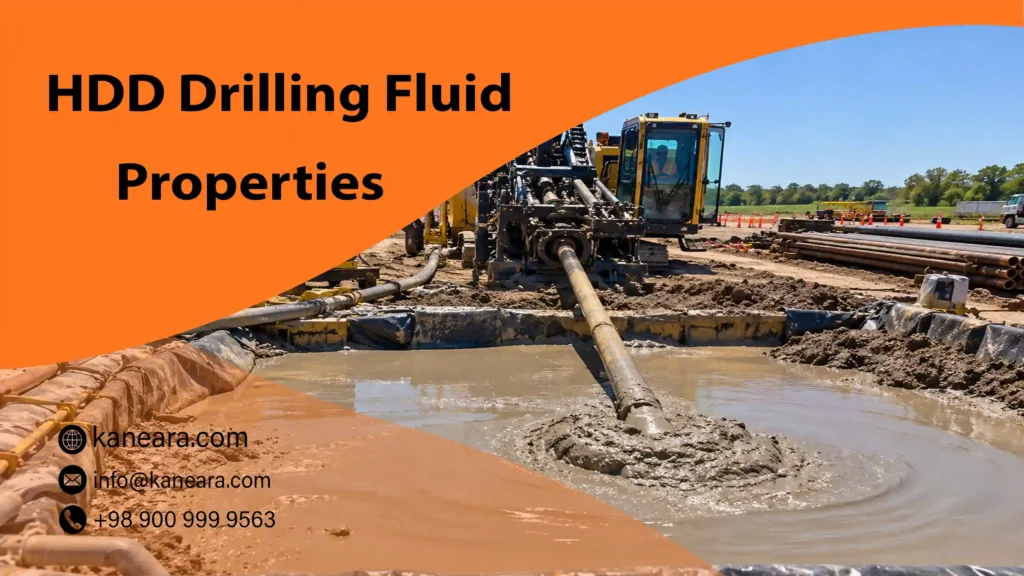
In horizontal directional drilling (HDD), drilling fluid must transport cuttings, support borehole stability, control fluid loss, and help lubricate drilling equipment. Its performance depends on several interacting properties, including viscosity, gel strength, filtration, density, and sand content, pH, and water quality.
Understanding these properties helps drilling teams monitor fluid condition, identify potential problems, and select suitable bentonite for different ground conditions. The appropriate operating targets depend on the formation, bore design, equipment, and project requirements.
Why Do Drilling Fluid Properties Matter in HDD?
During horizontal directional drilling, the bore remains occupied by drilling fluid and the soil cuttings generated during drilling and reaming. The fluid circulates through the annular space, carrying loosened material toward the surface while helping maintain suitable conditions around the bore.
If the fluid cannot transport cuttings effectively, solids may accumulate and interfere with circulation. If its resistance to flow becomes excessive, pumping pressures can increase. Inadequate filtration control can also affect fluid interaction with the surrounding ground.
For this reason, selecting an HDD drilling fluid involves balancing several objectives:
- Cuttings transport: Moving excavated soil through the bore and toward the return pit.
- Solids suspension: Limiting sedimentation when fluid circulation slows or stops.
- Borehole stability: Supporting the bore and controlling fluid interaction with the formation.
- Pressure management: Maintaining circulation without creating unnecessarily high hydraulic resistance.
- Lubrication and cooling: Reducing friction and helping manage heat around drilling tools.
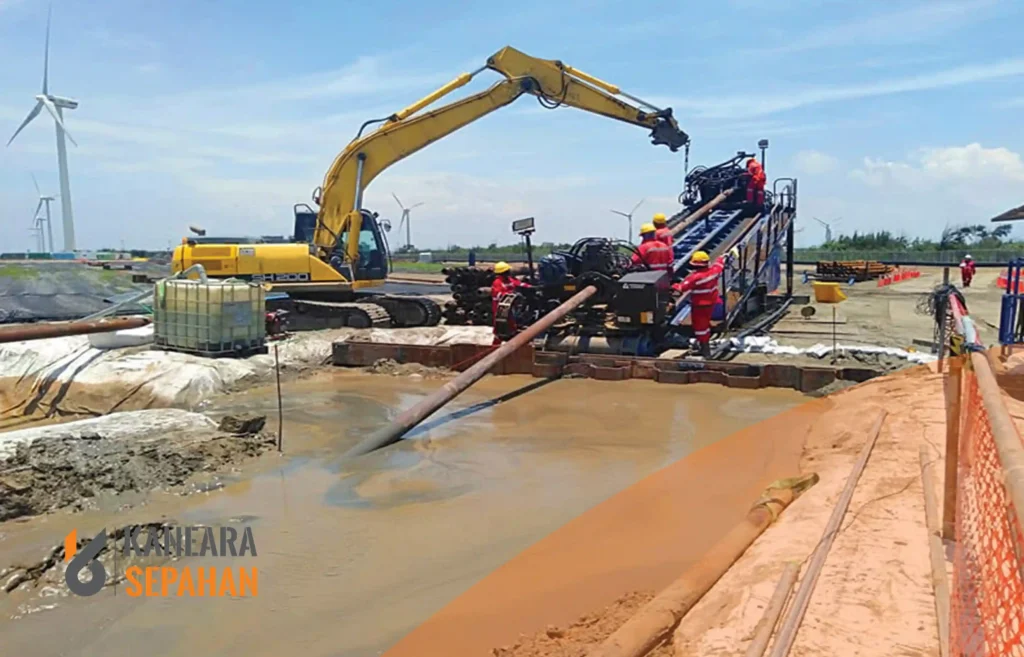
Key Properties of HDD Drilling Fluid
1. Viscosity
Viscosity describes a fluid’s resistance to flow. In HDD, suitable viscosity helps transport cuttings through the annular space. A Marsh funnel is commonly used for a quick field measurement of flow consistency.
Higher viscosity does not always mean better performance. Excessive resistance to flow can increase circulation pressure, while insufficient viscosity may reduce cuttings-transport capability. Results should be considered alongside gel strength, solids loading, and operating conditions.
Unexpected changes in viscosity may indicate problems with water quality, hydration, mixing, or the accumulation of solids in the return fluid. For more information, see our guide to why drilling bentonite loses viscosity.
Read more: Why Does Drilling Bentonite Lose Viscosity?
2. Gel Strength
Gel strength describes a drilling fluid’s ability to develop structure when it is at rest. It helps determine how effectively the fluid can suspend cuttings when circulation slows or stops.
Insufficient gel strength may allow solids to settle, while excessive gel strength can make circulation more difficult to restart. The goal is to achieve suitable suspension performance without creating unnecessary resistance during circulation.
3. Filtration and Filter Cake
Filtration is the movement of liquid from the drilling fluid into the surrounding formation. A filter cake is the layer of solids that may form on a permeable surface during this process.
Appropriate filtration control can help manage fluid invasion and support borehole stability. A filter press can be used to evaluate fluid loss and filter cake characteristics under specified test conditions.
Results depend on both the fluid formulation and the formation. A fluid-loss value alone cannot establish suitability for every soil type.
4. Fluid Density and Solids Loading
Fluid density measures mass per unit volume. In HDD, monitoring density can help identify changes in the circulating fluid as excavated material enters the system.
However, density is not the same as total solids content. A mud balance provides a practical density measurement, while additional tests are needed to understand the type and amount of solids present.
Increasing density in return fluid may indicate solids accumulation. The drilling team should also check sand content, circulation performance, and solids-separation equipment before adjusting the fluid.
5. Sand Content
Sand content measures the proportion of sand-sized particles in the fluid. Excessive sand can increase wear on pumps and other equipment and may indicate that coarse solids are not being adequately removed.
A dedicated sand-content kit is commonly used for field testing. Results are most useful when compared with density, viscosity, and observations of the returning fluid.
6. PH and Water Quality
Water chemistry affects how bentonite hydrates and develops its fluid properties. Dissolved salts and water hardness can influence viscosity, gel strength, and filtration behaviour.
PH is an important indicator, but it does not provide a complete assessment of water quality. Where performance problems occur, tests for hardness, salinity, or conductivity may help identify the cause.
Testing the makeup water before mixing provides a useful baseline. Adding more bentonite without investigating water quality, hydration time, and mixing conditions may not resolve the underlying problem.
7. Lubricity
Lubricity describes the ability of a fluid to reduce friction between contacting surfaces. In HDD, it can influence the movement of drilling tools and the forces involved in product-pipe installation.
A suitable viscosity does not automatically mean that a fluid has adequate lubricating performance. Lubricity requirements depend on the ground, bore geometry, equipment, and project conditions.
Read more: what is bentonite?
How to Test HDD Drilling Fluid
Testing both freshly prepared fluid and returning fluid helps reveal how properties change during drilling.
| Test or equipment | What it measures or indicates |
|---|---|
| Marsh funnel | Flow consistency under specified test conditions |
| Rheometer | Rheological properties, including gel strength when measured by the applicable procedure |
| Mud balance | Fluid density |
| Sand-content kit | Proportion of sand-sized particles |
| Filter press | Fluid loss and filter cake characteristics |
| pH test | Acidity or alkalinity of the fluid or makeup water |
| Water-hardness or conductivity test | Additional information about water chemistry |
Testing frequency should follow the project’s fluid-control programme. Additional testing may be necessary when ground conditions change, return-fluid properties shift, or circulation performance deteriorates.
Common HDD Drilling Fluid Problems
Unexpected readings should prompt investigation rather than automatic changes to the fluid formulation.
| Observed problem | What to check |
|---|---|
| Lower-than-expected viscosity | Water quality, mixing, hydration time, dosage, and product characteristics |
| Increasing viscosity in return fluid | Solids accumulation, density, sand content, and solids-control performance |
| Poor cuttings suspension | Gel strength, particle characteristics, and circulation conditions |
| Unexpected fluid loss | Test conditions, water chemistry, formation characteristics, and formulation compatibility |
| Rising circulation pressure or deteriorating returns | Hydraulic conditions, solids accumulation, and hole-cleaning performance |
Individual readings rarely explain the entire problem. Comparing trends across several tests and reviewing actual drilling conditions provides a more reliable basis for corrective action.
Conclusion
Effective HDD fluid management depends on balancing cuttings transport, suspension, filtration control, solids loading, and lubricity. Regular testing of prepared and returning fluid helps drilling teams identify changes and make informed adjustments.
The most suitable bentonite and fluid properties depend on the project conditions. Evaluating these factors together provides a stronger basis for fluid selection and performance monitoring than relying on a single measurement.
Frequently Asked Questions
1- What are the most important HDD drilling fluid properties?
The main properties include viscosity, gel strength, filtration, filter cake quality, density, sand content, pH, water chemistry, and lubricity. Their importance varies with ground conditions and the drilling programme.
2- Does higher viscosity always improve HDD performance?
No. Higher viscosity may help transport cuttings in some conditions, but excessive resistance to flow can increase circulation pressure. Viscosity should be assessed alongside other fluid properties.
3- What is the difference between fluid density and sand content?
Density measures mass per unit volume, while sand content measures the proportion of sand-sized particles. These tests provide different information and should not be treated as interchangeable.
4- How does water quality affect bentonite drilling fluid?
Water chemistry can influence bentonite hydration, viscosity, gel strength, and filtration. pH alone may not identify all water-quality issues, so additional tests may be appropriate.