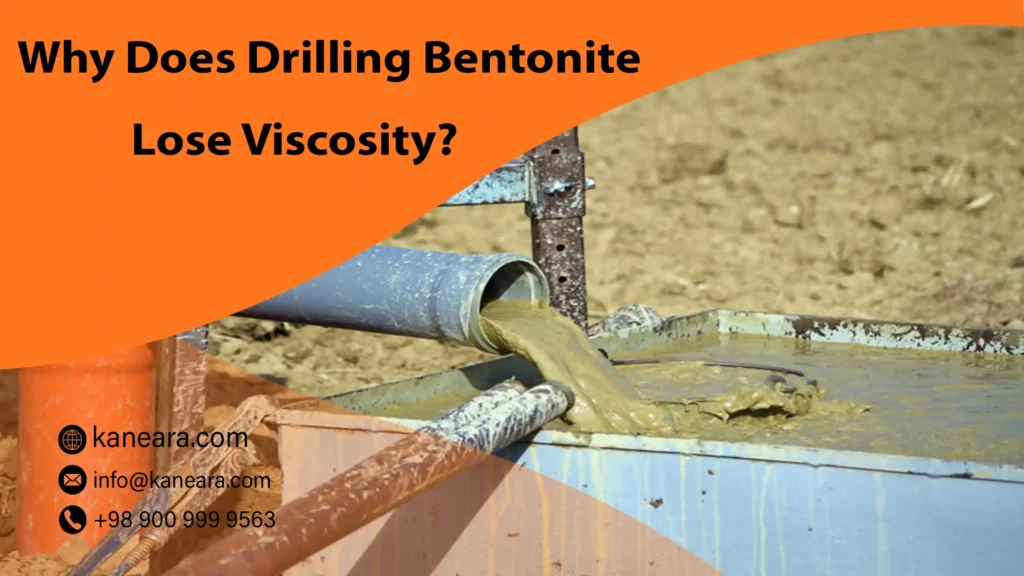
A drilling mud that remains thinner than expected can reduce cuttings-carrying capacity, weaken suspension performance, and affect borehole stability. Adding more bentonite is not always the right solution. Water chemistry, incomplete hydration, poor dispersion, and unsuitable material grades can all contribute to low viscosity.
Before changing the dosage, identify where the problem occurs and check the following factors.
Troubleshoot Low Viscosity in Drilling Bentonite
1. Check Water Quality before Adding More Bentonite
Water quality is one of the first things to investigate when drilling bentonite fails to develop the expected viscosity.
Hard water: Calcium and magnesium ions can interfere with bentonite swelling and dispersion. As a result, the slurry may develop less viscosity than expected, even when the correct amount of powder has been added.
Saline water: Dissolved salts can suppress clay hydration and promote particle aggregation. This may reduce viscosity and gel strength and can also worsen fluid-loss performance.
What to do: Test the makeup water for hardness, salinity or conductivity, and ph. If the water is unsuitable, evaluate an alternative water source or an appropriate pretreatment under the project’s fluid-control procedure. Do not assume that adding more bentonite will compensate for unsuitable water.
2. Allow Enough Time for Hydration
When preparing bentonite drilling mud, remember that bentonite does not necessarily develop its full rheological properties immediately after mixing. Its performance depends on the clay’s characteristics, water chemistry, particle size, mixing energy, and hydration time.
If viscosity is measured immediately after adding the powder, the result may underestimate the slurry’s eventual performance.
What to do:
- Allow the slurry to hydrate for the period recommended in the product’s technical data sheet and drilling-fluid procedure.
- Maintain suitable agitation during preparation and hydration.
- Measure viscosity again after the designated hydration period, using consistent test conditions.
If viscosity improves with time, incomplete hydration may be contributing to the problem. If it remains low, investigate water chemistry, mixing efficiency, and material quality.
3. Improve Mixing and Powder Dispersion
Even suitable bentonite can perform poorly when it is not dispersed uniformly. Adding powder too quickly, using insufficient mixing energy, or working with equipment that creates dead zones can produce lumps and poorly hydrated particles.
These problems reduce the amount of clay effectively contributing to the slurry’s rheology.
What to do:
- Fill the mixing tank with the specified amount of suitable water.
- Start the mixer and establish effective circulation before adding bentonite.
- Add the powder gradually into the water rather than pouring water onto a concentrated mass of powder.
- Continue mixing until the slurry is visually uniform, without persistent lumps.
- Allow the recommended hydration period before evaluating performance.
Also check the mixer, tank circulation, and powder-feeding method if the same problem occurs repeatedly.
Read more: Drilling Industry
4. Identify the Cause of Low Viscosity
Use the following table to connect common field observations with the next diagnostic step.
| Observation | Possible cause | Recommended action |
| Viscosity is low immediately after mixing but improves later | Incomplete hydration | Allow the specified hydration period and retest. |
| Different water sources produce different results | Water hardness or salinity | Test both sources and assess water suitability. |
| Dry lumps remain in the slurry | Poor powder dispersion | Review powder-feed rate, mixer performance, and circulation. |
| Viscosity remains low after proper hydration | Unsuitable grade, low effective clay content, or contamination | Check the batch documentation, water chemistry, and product specifications. |
| Viscosity decreases after adding other materials | Chemical incompatibility or contamination | Review the addition sequence and test the fluid system for compatibility. |
| Viscosity is acceptable but fluid loss is excessive | Filtration-control problem | Perform a fluid-loss test and review the complete mud formulation. |
These observations indicate possible causes rather than definitive diagnoses. More than one factor may be responsible.
5. Measure Viscosity and Fluid Loss Separately
A drilling fluid should not be evaluated by viscosity alone. A thicker slurry does not automatically provide better filtration control or overall drilling performance.
A Marsh funnel test provides a practical field indication of flow behavior. Use a clean funnel, a consistent sampling procedure, and comparable sample temperatures when tracking changes between batches.
For applications requiring more detailed rheological control, additional measurements such as plastic viscosity, yield point, and gel strength may be necessary, depending on the project specification.
Fluid loss should be measured separately using the applicable filtration test method. If viscosity meets the target but filtration performance does not, increasing bentonite concentration may not address the underlying issue.
Read more: What is bentonite
6. When Should You Reconsider the Bentonite Grade?
If water quality, mixing, and hydration have been checked but the slurry still fails to meet the required performance, review the bentonite grade and its supporting test data.
Different drilling applications can require different combinations of yield, viscosity, and filtration control. Selection should therefore be based on the actual drilling conditions and applicable technical specification, not simply on the product name.
Review the certificate of analysis (COA), technical data sheet (TDS), and relevant performance results. For projects involving oil and gas wells, verify any required API specification; for civil drilling, assess the requirements of the particular operation.
The key takeaway: Low drilling-mud viscosity is a symptom, not a diagnosis. Checking water chemistry, hydration, and mixing first can help identify the actual cause before unnecessary material additions or formulation changes increase costs.
Conclusion
Before adjusting the formulation, confirm that:
- The makeup water has been checked for hardness and dissolved salts.
- The powder has been added gradually under effective mixing conditions.
- The slurry has received sufficient hydration time.
- Viscosity has been measured consistently and compared with the project target.
- Fluid loss has been checked independently where required.
- The bentonite grade and batch documentation match the application’s specifications.