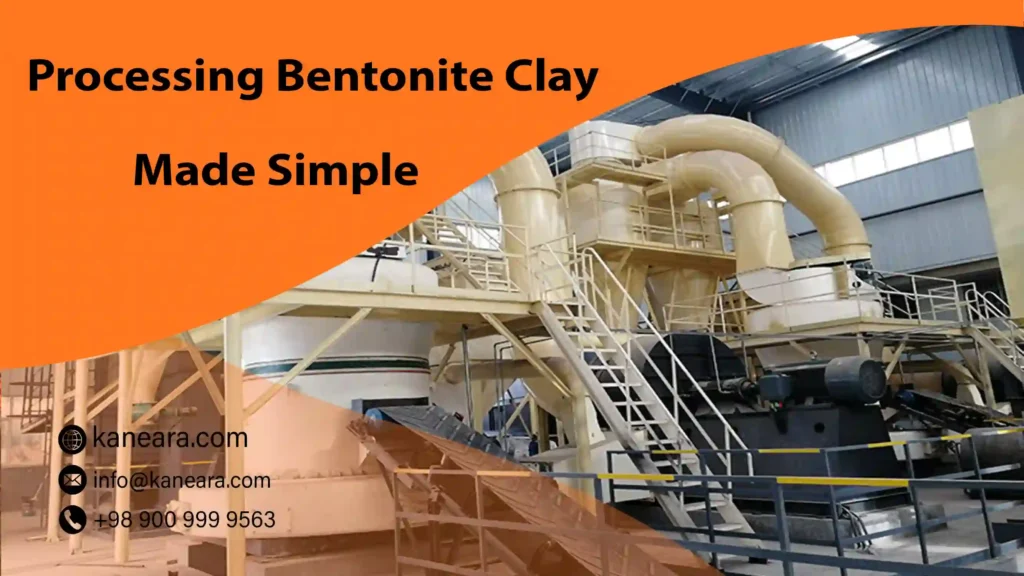
Bentonite processing transforms raw bentonite clay into a consistent material suitable for specific industrial applications. The process typically involves mining, crushing, drying, grinding, and particle-size classification. Depending on the mineral composition and intended use, additional steps such as blending, sodium activation, or granulation may also be required. For those wondering how to make bentonite clay suitable for a specific application, selecting the right processing methods is essential.
The processing method determines important product characteristics, including moisture content, particle size, swelling behavior, and handling properties. Understanding how raw bentonite is processed helps buyers and technical teams evaluate the suitability of different bentonite grades for their applications.
What Is Bentonite Processing?
Bentonite processing is the controlled preparation of mined bentonite so that it achieves the physical and technical characteristics required for a specific application.
Freshly mined clay can contain:
- High and variable moisture
- Oversized clay lumps
- Natural mineral impurities
- Variable particle sizes
- Different levels of swelling or absorption performance
Processing helps manufacturers control these variables and produce a more consistent material.
The most important processing steps may include:
| Processing stage | Main purpose |
|---|---|
| Mining | Extract bentonite-bearing clay |
| Crushing | Break down large lumps |
| Drying | Reduce excess moisture |
| Grinding | Produce the required particle size |
| Classification | Separate particles by size |
| Activation or blending | Modify or standardize performance where required |
| Granulation | Produce uniform granules for selected applications |
| Quality control | Verify the final specifications |
| Packaging | Protect the processed material during storage and transport |
The exact sequence varies according to the deposit and the final use.
Step 1: Mining and Extraction
Bentonite is generally extracted from surface deposits using conventional open-pit mining methods.
The clay is removed in layers, and mining equipment such as excavators and loaders is used to extract and transport the material.
At this stage, the bentonite clay is still a raw mineral rather than a finished industrial product.
Its properties can vary depending on:
- Mineral composition
- Montmorillonite content
- Natural moisture
- Deposit characteristics
- Associated minerals and impurities
Because of this natural variation, the material usually requires further preparation before it can be processed into a consistent commercial grade.
Step 2: Crushing and Initial Preparation
Large pieces of raw bentonite are reduced in size before they enter the main processing line.
Primary crushing can make the material easier to handle and prepare it for more controlled drying and grinding.
Depending on the operation, initial preparation may also involve:
- Removing oversized material
- Breaking compacted clay lumps
- Separating unwanted debris
- Managing stockpiles from different parts of the deposit
Blending material from different stockpiles can also help reduce natural variability before further processing.
Step 3: Drying the Bentonite
Drying is one of the most important stages in bentonite processing because mined clay can contain substantial amounts of natural moisture.
The objective is not simply to remove as much water as possible. The drying conditions need to produce a material that can be efficiently ground, screened, transported, and stored while maintaining the properties required for its application.
Industrial drying systems can include equipment such as rotary dryers and other continuous drying technologies.
The required moisture level depends on the final product. Excess moisture can create problems with:
- Grinding efficiency
- Material flow
- Storage stability
- Packaging
- Particle separation
At the same time, processing conditions should be controlled carefully because excessive thermal treatment may affect the performance of some bentonite grades.
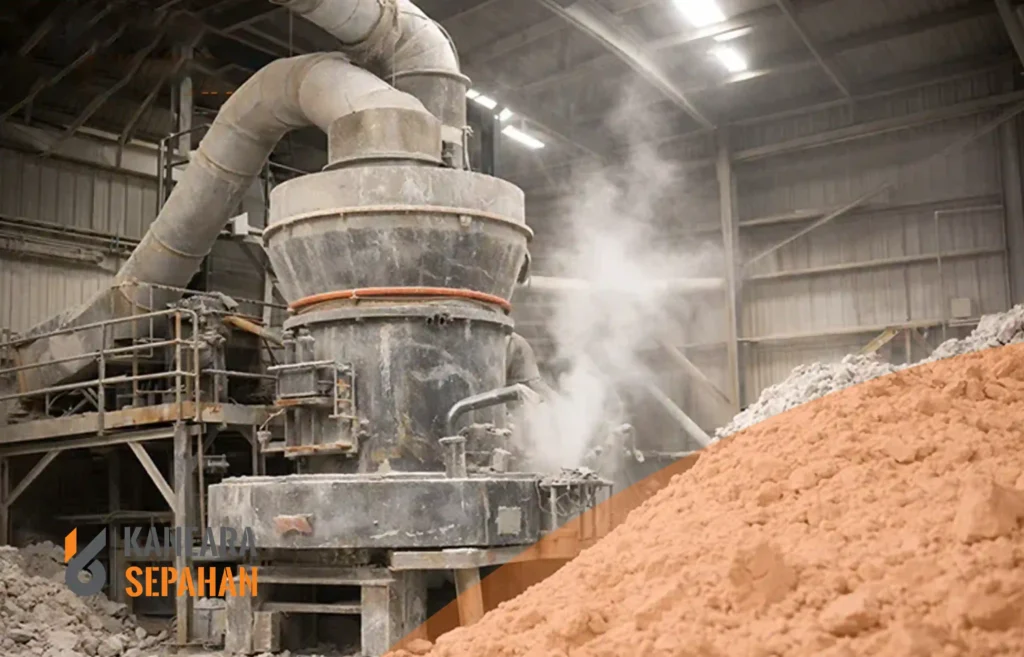
Step 4: Grinding and Pulverizing
After drying, bentonite may be ground to achieve the required particle size.
This is a key stage because particle size influences how the material behaves during mixing, dispersion, handling, and application.
The desired fineness depends on the intended use. A fine powdered grade may be required for one application, while another process may call for a coarser particle distribution.
Common types of grinding or pulverizing equipment used in mineral processing may include:
- Raymond-type mills
- Hammer mills
- Pulverizers
- Other industrial milling systems
The objective is not necessarily to produce the finest possible powder. Instead, the target is a controlled particle-size distribution that matches the technical requirements of the end use.
Step 5: Classification and Screening
Grinding does not always produce particles of the same size.
Classification and screening are therefore used to separate material into the required particle-size ranges.
This stage can help:
- Remove oversized particles
- Control fine-particle content
- Improve product consistency
- Meet customer specifications
- Return oversized material for additional processing when appropriate
Particle-size control is particularly important when a customer requires a defined mesh range or consistent granule size.
Read more: What is bentonite?
Step 6: Activation or Blending
Some bentonite products require additional treatment to achieve the desired functional properties.
One important example is sodium activation of calcium-dominant bentonite. In suitable materials, sodium compounds such as soda ash may be used to modify ion exchange characteristics and improve swelling behavior.
However, activation is not a universal requirement for all bentonite.
The need for activation depends on:
- The original mineral composition
- The type of bentonite
- The target application
- Required swelling and rheological properties
- Customer specifications
Blending may also be used to achieve a more consistent product by combining materials with different characteristics.
This means that the final performance of bentonite is determined not only by particle size, but also by mineralogy and processing conditions.
Step 7: Granulation
Not all bentonite is sold as a powder.
For applications that require larger and more uniform particles, processed bentonite can be formed into granules.
A typical granulation process may involve:
- Preparing the ground material
- Adding controlled moisture or binder where required
- Forming particles in a granulator or pelletizing system
- Drying the newly formed granules
- Screening them to the required size range
Granulation can improve:
- Flowability
- Dust control
- Handling
- Packaging performance
- Uniformity of particle size
This stage is especially relevant to selected absorbent and granular bentonite products.
Step 8: Quality Control and Testing
Processing does not end when the material reaches the desired particle size.
Laboratory testing is needed to determine whether the finished bentonite meets the technical requirements of its intended application.
Depending on the grade, quality control may include tests related to:
- Moisture content
- Particle-size distribution
- Swelling capacity or swelling index
- Water absorption
- Rheological behavior
- Yield or viscosity-related properties
- Bulk density
For industrial buyers, the most useful quality data depend on the application. A drilling-grade bentonite, for example, may require different performance specifications from an absorbent or construction-grade material.
A consistent testing program helps identify variation between production batches and ensures that the material is suitable for its specified use.
Step 9: Packaging and Storage
After processing and quality control, bentonite is packaged according to the requirements of the customer and the product form.
Common packaging formats include:
- Paper or multi-wall bags
- Woven polypropylene bags
- Jumbo bags
- Bulk shipments
Storage conditions are also important.
Because processed bentonite can interact with moisture, the material should generally be protected from water and excessive humidity during storage and transportation.
Poor storage conditions can change the physical condition of the product and affect handling before it reaches the customer.
Read more: Drilling Industry
Does Every Bentonite Product Use the Same Processing Method?
No. This is an important point when discussing the bentonite manufacturing process.
Different products may require different combinations of processing steps.
The actual processing route depends on the characteristics of the raw material and the technical requirements of the final product.
What Determines Bentonite Processing Quality?
Several factors can influence the quality and consistency of processed bentonite.
- Mineral composition: A deposit with a high proportion of montmorillonite may behave differently from material containing greater amounts of associated minerals.
- Moisture control: Uneven drying can create handling and milling problems and make it more difficult to maintain consistent particle size.
- Grinding conditions: The milling system and operating conditions influence particle-size distribution and product uniformity.
- Activation and blending: Where required, controlled activation or blending can help achieve more consistent functional performance.
- Quality testing: Laboratory testing provides evidence that the processed material meets the specifications required for its intended application.
Bentonite Processing vs. Bentonite Manufacturing
These terms are often used interchangeably, but there is a useful distinction.
Bentonite processing focuses on operations such as drying, grinding, classification, activation, and granulation that prepare the mined clay for use.
Bentonite manufacturing is a broader term that can describe the entire production chain, from raw-material extraction through processing, quality control, and final packaging.
For industrial buyers, understanding the processing route can be useful when comparing materials from different suppliers because two products described simply as bentonite may have significantly different physical and performance characteristics.
Why Does Bentonite Processing Matter?
The quality of the raw deposit is important, but processing determines how consistently that material can be delivered in a usable form.
A well-controlled process can help achieve:
- Consistent particle size
- Controlled moisture
- Predictable swelling or absorption behavior
- Better flowability
- Improved handling
- More consistent batch quality
For this reason, evaluating bentonite only by its mineral name is not enough. Buyers should also consider the product specification, testing data, particle size, moisture, and suitability for the intended application.
Conclusion
So, how is bentonite processed?
The process typically begins with mining and preparation of the raw clay, followed by controlled drying, grinding, classification, and, where necessary, activation, blending, or granulation. The finished material is then tested and packaged according to its intended application.
The most important point is that there is no single processing route for every bentonite product. The required steps depend on the mineral characteristics of the deposit and the physical and performance specifications of the final grade.
Understanding these stages helps buyers and technical users evaluate bentonite more effectively and recognize why processing quality can have a direct impact on consistency, handling, and application performance.
Frequently Asked Questions (FAQs)
1- How is bentonite clay made from raw material?
Bentonite clay is made by extracting natural clay, then drying, grinding, and sometimes granulating it to achieve specific physical properties.
2- What is the most important step in bentonite processing?
Drying is one of the most critical steps because it affects grinding efficiency and final performance.
3- Is the bentonite clay manufacturing process the same for all applications?
No. Processing steps and particle size vary depending on whether the bentonite is used for drilling, oil refining, cat litter, or construction.
4- Why is granulation necessary in bentonite clay production?
Granulation improves handling, reduces dust, and creates uniform particles for specific applications.
5- What is sodium activation of bentonite?
Sodium activation is a treatment used with certain bentonite materials to modify their performance, particularly swelling behavior. It is not required for every type of bentonite and depends on the mineral characteristics and final application.